

Next steps for 2026-2027 Bargaining
Canada’s bilingualism works because we do. It’s time to make our workplace work for us.
This is a pivotal moment for TRs. Cuts and AI-first choices are weakening the Translation Bureau and putting increasing pressure on us, the professionals whose expertise makes Canada’s bilingual public service possible.
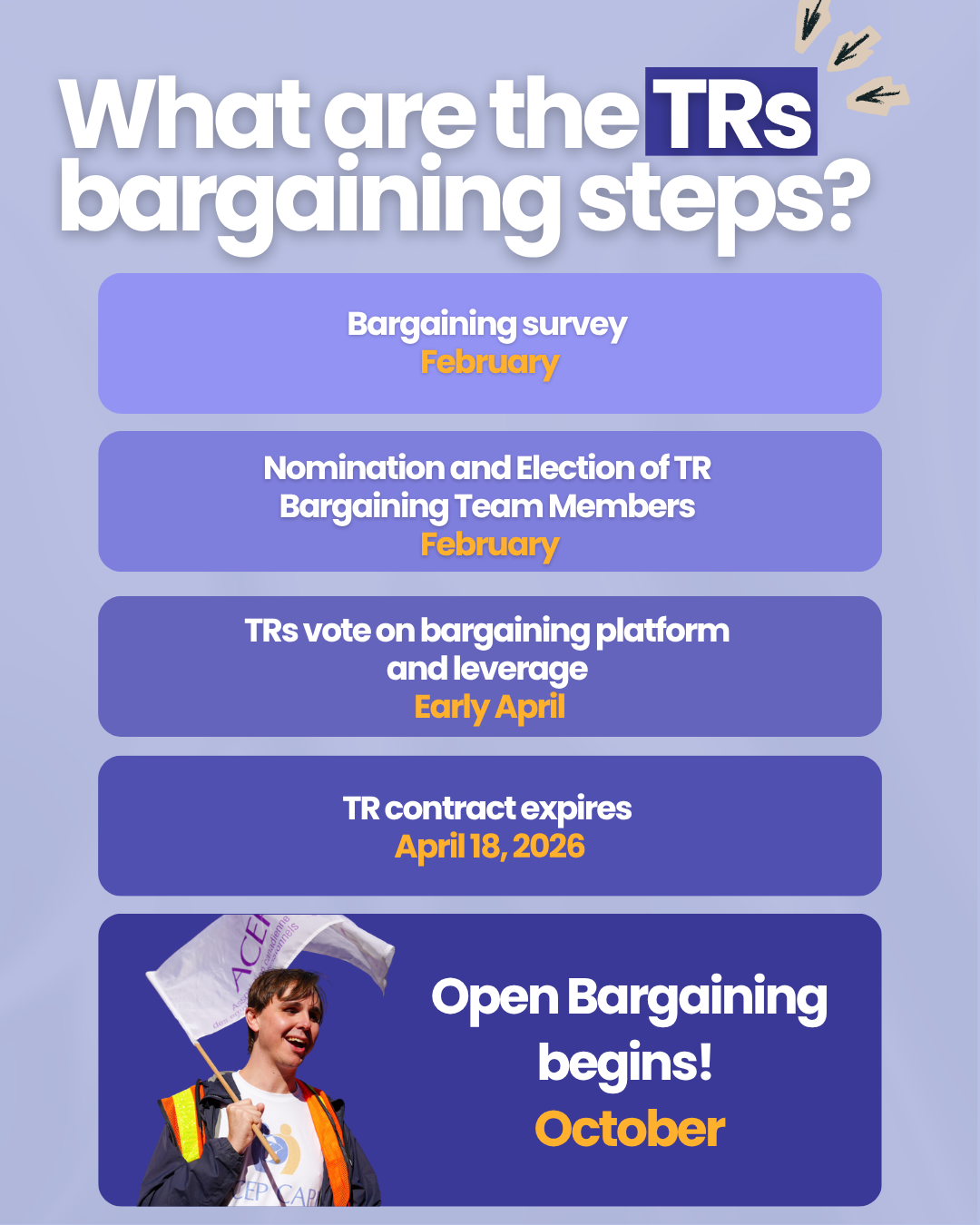
Linguistic services are fundamental to our public services, and we play a critical role in delivering them. AI, telework, workload, health and safety: these will all be on the table, and it's up to us to win the meaningful improvements we need to protect our professional integrity and ensure we have what we need to do our work well. Bargaining is starting on October 21 and 22, 2026. Under our open bargaining model, you will have more opportunities to follow what is happening at the table, participate throughout the process and build the collective power you need to win meaningful improvements.
You chose conciliation
You voted to use conciliation as the dispute resolution process for this round of bargaining.
In the conciliation process, you keep the right to take legal job actions like work-to-rule, slow downs or strike action. These options become available only after the parties reach an impasse at the table, go through the conciliation step (which produces non-binding recommendations), and you vote in favour to take job action. All bargainable issues stay on the table throughout the process — including new and breakthrough provisions. Also, under conciliation, bargaining issues can still be referred to arbitration if agreed to by the employer and the union. Check out the UPDATED Q&A below for more info on conciliation and next steps.
Status of bargaining
The first bargaining session for your new collective agreement are scheduled for October 21st and 22nd 2026.
Once bargaining is underway, you will receive regular updates on what is happening at the bargaining table and what you can do to influence it. You will also be able to follow the evolution of proposals at the table through the online proposal tracker that will be updated regularly.
- View bargaining updates (register here if you can't log in)
- View proposal tracker (coming soon)
Your bargaining committee
Your bargaining committee is made up of representatives from across the Translation Bureau.
It brings your priorities to the bargaining table, represents you during negotiations and helps keep you connected to what is happening throughout the process. However, your bargaining committee will never win the gains you need for you; to win, each TR needs to put their shoulder to the wheel and build the collective power needed for breakthroughs at the bargaining table.
TR Organizing Committee
The TR Organizing Committee connects you and your colleagues and is the main way to get involved in bargaining. By talking to your coworkers and participating in bargaining actions, you build the collective power needed to win the meaningful gains we all need at the table.
You are not a bystander waiting to hear what a third party decided for you. You are part of deciding whether you have the necessary power to takes on the issues that are already reshaping your life like AI, workload, telework, health and safety or attacks on your professional integrity.
Essential Services Agreement
Because you chose conciliation, an essential services agreement (ESA) needs to be negotiated with the employer.
Under the Federal Public Sector Labour Relations Act (FPSLRA), an essential service is defined as a service, facility or activity of the Government of Canada that is necessary for the safety or security of the public, or a segment of the public.
In practical terms, an ESA determines which positions must continue performing work in the event of a legal strike. Essential does not simply mean that a job or service is important. Preventing a unionized worker from striking is a serious limitation on one of their most important fundamental rights, which is why your ESA committee will hold the employer to the highest standard throughout this process and may call on you to gather useful information on the work you do.
Questions about TR bargaining?
Have questions about bargaining? Contact your Bargaining Committee.
Stay informed
Don’t miss an important bargaining update, meeting or vote. Make sure your membership information is up to date and that CAPE has your personal email address so you receive important bargaining communications.
2026-27 Bargaining Q&A
In the Canadian federal public sector, an impasse means the union and employer have reached a point in bargaining where they cannot get to a tentative agreement through negotiations alone. It’s when the parties cannot move forward with bargaining either because a party has no mandate or there’s no way to reach an agreement on issues.
It usually comes after multiple bargaining rounds of bargaining, exchanges of proposals, counterproposals, withdrawals, modifications, and attempts to narrow the issues, because bargaining is normally a back-and-forth process where each side tests priorities and trades movement on some demands for movement on others. Think about negotiating the price of a car or a house: you may not want to pay the asking price, so you’ll need to decide how many counteroffers to make and when to walk away.
In the conciliation route, either the union or employer can declare an impasse when they are unable to reach an agreement.
When the parties reached an impasse, and request conciliation, the Federal Public Sector Labour Relations and Employment Board (FPSLREB) can delay establishing a Public interest Commission (PIC) until they are satisfied that the parties have bargained “sufficiently and seriously". The Chairperson can encourage the parties to resume negotiations or work with a mediator.
In the arbitration route, if the parties cannot reach a tentative agreement, either party may ask the FPSLREB to establish an arbitration board, which issues a binding decision.
Under an open bargaining model, members will receive more regular updates about what is happening at the bargaining table than they have in past rounds of bargaining. CAPE’s goal is to make bargaining more transparent, participatory, and member-driven, while still protecting the bargaining team’s ability to negotiate strategically. This means members can expect updates on major developments, employer proposals, CAPE’s proposals, key issues under discussion, and moments when member action may be needed to strengthen the bargaining team’s position. Some details may still need to remain confidential during negotiations, especially when sharing them publicly could weaken CAPE’s leverage. But the overall direction is clear: members should not be left in the dark while decisions about their contract are being made. The exact way in which the updates will be sent to you and posted will be coming in the next few months.
The employer should not target, punish, intimidate, or treat members differently because CAPE is bargaining or because members are participating in union activity. Bargaining can sometimes make the workplace feel more tense. Managers may receive direction from Treasury Board or departments about communications, operations, or labour relations. But that does not give management the right to retaliate against members or interfere with lawful union activity. Your day-to-day rights at work still apply. The collective agreement still applies. Normal workplace rules still apply. If you experience pressure, threats, unusual scrutiny, discipline, or retaliation connected to bargaining or union participation, document what happened and contact CAPE.
Members have the right to participate in their union and in lawful bargaining-related activity. The employer cannot discipline, threaten, intimidate, or retaliate against members simply because they are members of CAPE, participate in union activity, vote, attend union meetings, support bargaining priorities, or exercise their rights. That said, members should make sure their participation is lawful and appropriate. For example, members should not engage in illegal strike activity, block access to workplaces, threaten anyone, misuse employer resources, or participate in union activity during working time unless they are on approved leave or otherwise authorized. If a manager threatens you, pressures you, discourages you from participating, asks how you voted, or treats you differently because of union activity, contact CAPE: representation@acep-cape.ca
The Rootham decision, involving the Alliance at Parliament, is an arbitral award that clarified some of the telework issues that can be negotiated. It has become an important reference point on telework. However, it unfortunately comes from a different jurisdiction than CAPE members. While that jurisdiction is similar to the FPSLREA framework, it is not exactly the same.
There is no path where concessions are impossible. No matter which dispute resolution process members choose, the employer will likely come to the table looking for concessions, and CAPE will have to fight to protect members’ rights, working conditions, and wages. The difference is not that one path guarantees losses, and the other prevents them. The difference is where your power comes from. Under conciliation, members keep more collective leverage. If the parties cannot reach a deal, conciliation can lead to job action, but only if members vote for it. That does not mean a strike is automatic. It means members preserve the ability to increase pressure on the employer if needed. That pressure can be an important tool for resisting concessions and pushing for stronger gains. So, the question is not simply, “Which path has fewer risks?” Both paths carry risks. The question is: Which path gives members the best chance to build power, push back on concessions, and win the strongest possible agreement CAPE’s position is that member participation will be critical either way. The stronger and more organized members are, the better our chances of resisting concessions and winning improvements at the table.
Under conciliation, members’ power comes from collective pressure. Conciliation keeps more options on the table if the employer refuses to move. That can include public pressure, workplace organizing, coordinated member action, work-to-rule, strategic or rotating strikes, or a broader strike — but only if the legal requirements are met and members vote for that step. This matters because some issues are hard to win through arguments alone. Issues like telework, workload, AI protections, job security, and stronger worker voice may require visible member support and pressure outside the bargaining room. Conciliation gives members more leverage to push back against concessions and fight for a stronger agreement.
In collective bargaining, a placeholder is a proposal under an existing article or a new article being proposed stating something along the lines of "The Association reserves the right to table further proposals about ….” It allows the union to indicate its intention to address the issue later in bargaining while maintaining the flexibility needed to further define its position and submit a detailed proposal at the appropriate moment.