
In 2026, the collective agreements for CAPE’s two largest groups will expire: EC and TR members. This upcoming round of bargaining will be different. It will be fundamentally transparent and led by members themselves.
Previously, CAPE’s approach to bargaining was to keep everything confidential and closed off, with very low participation from members. The entire bargaining process was decided by a handful members appointed by the National Executive Committee (NEC) and staff.
This year, CAPE’s new leadership is flipping that model on its head. This year, every EC & TR member will be able to observe and participate in negotiations for their new contract.
What Is Open Bargaining?
Open Bargaining is a collaborative, member-driven process that dramatically increases rank-and-file participation in negotiations. It replaces closed-door discussions with open democratic engagement, where members help shape proposals, sit at the bargaining table, and directly determine bargaining strategy.
This approach is grounded in one belief: our strength at the table depends on how much collective power we’ve built.
Unions that adopt Open Bargaining routinely secure some of the strongest contracts in their sector, not just on wages, but on groundbreaking workplace protections and new rights for members.
Open bargaining has been adopted by many unions across North America to great success.
Open Bargaining brings
- Transparency: Continuous information flow on bargaining developments
- Democracy: Participate directly in shaping demands
- Power in numbers: A more engaged membership means a stronger bargaining position
This isn’t just a communications tool: it’s a structural change in how we negotiate. And it’s designed to win.
How is Open Bargaining Different?
There are a couple fundamental elements that make Open Bargaining different (and more powerful) than the conventional confidential model.
Key elements of open bargaining
- A big representative bargaining committee that is elected
- Vote on bargaining priorities by members ahead of negotiations
- No confidentiality agreements with the employer that limit communication with members
- Open sharing of the employer’s proposals with members
- All members can join Article Committees
- Members are invited to observe and influence negotiations
- Comprehensive communications to members after every negotiation session
- The process is transparent and democratic.
The first major difference is that the bargaining committee is big and representative of all members within the bargaining unit. Further, committee members are elected by their co-workers.
Second is the development of priorities and proposals. In the past, members filled out a bargaining survey ahead of negotiations and then had no input until the very end when they were shown a tentative agreement to approve. This time, the bargaining committee will analyze the results of the survey and draft bargaining priorities. Those bargaining priorities will then be presented to members at a special general meeting to vote on before negotiations start.
Third, there are no ground rules or agreements with the employer about confidentiality that restrict what can be shared with members.
Fourth, when the employer presents their proposals, CAPE will share them with members. It’s important for all members to see for themselves what changes their employer plans to make to their working conditions.
Fifth, the bargaining committee will strike subcommittees of members to decide how major articles of the collective agreement should be changed. These Article Committees will be chaired by bargaining committee members but will be open to all members.
Sixth and seventh, any member in good standing of the bargaining unit can observe the negotiation sessions and CAPE will communicate comprehensive updates to all members following each session.
Finally, this process is transparent, inclusive, and grounded in solidarity among the members, across bargaining units, and with other unions. All meetings and decisions happen with and by members of the bargaining committee
The Open Bargaining Process
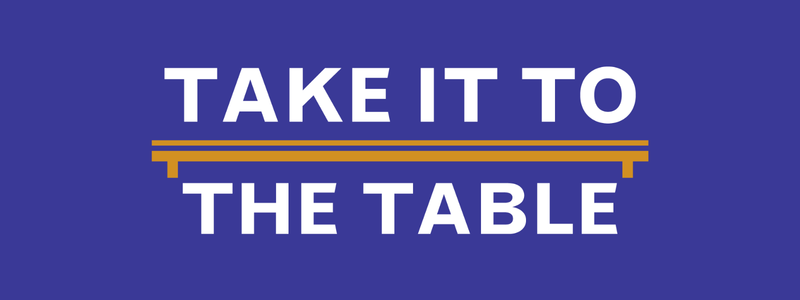
EC Bargaining - Milestones
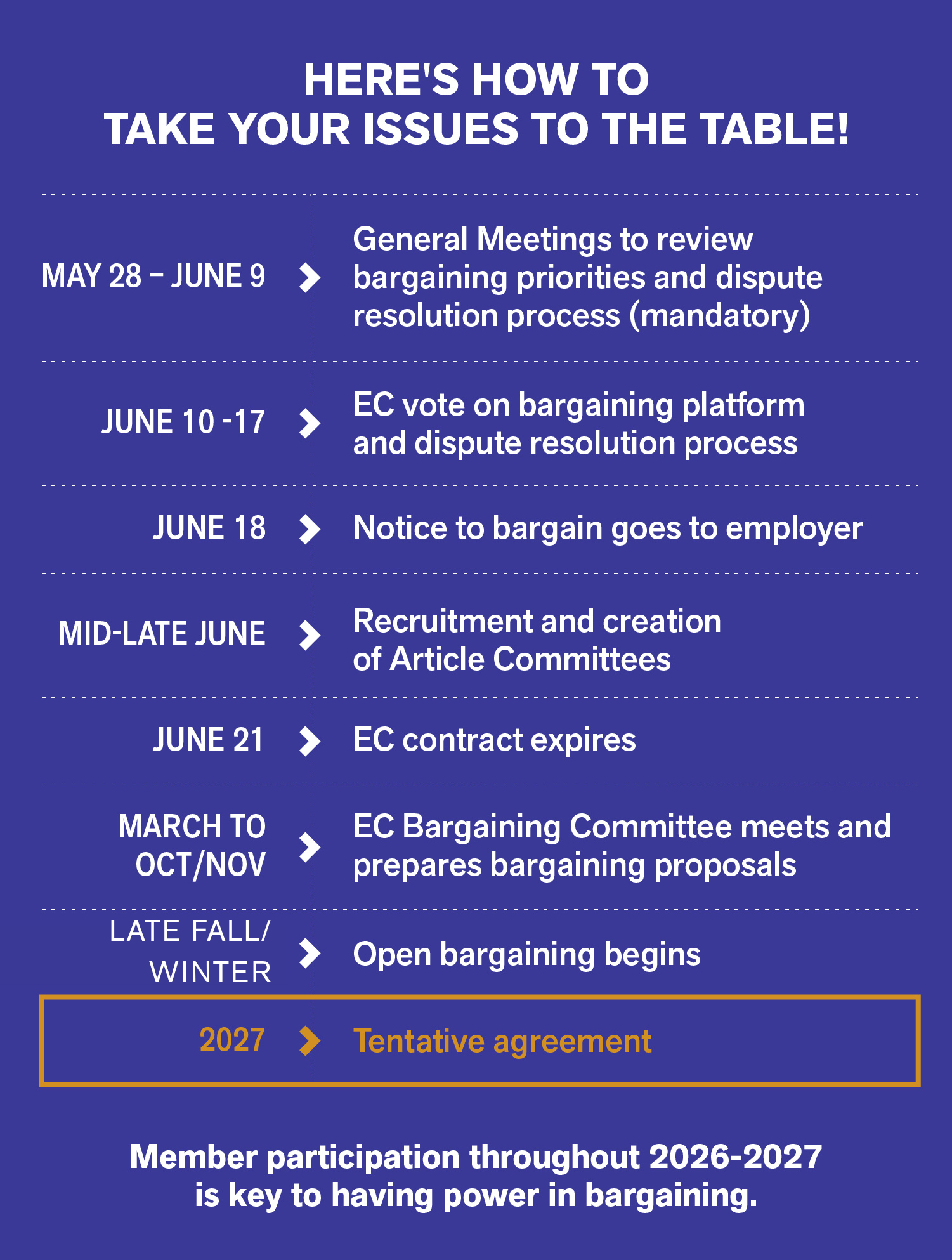
TR Bargaining - Milestones
| Event | Timeline |
| Nov 2025 – Feb 16, 2026 (emailed to all members Feb 2) |
| Feb 20-23, 2026 |
| April 2026 |
| April 2026 |
| April 18, 2026 |
| October 2026 |
Phase 1 Bargaining survey
The first step is the bargaining survey. Past practice at CAPE was simply to email out the survey to all members for whom we had email addresses. Email is an important tool but one challenge with that approach is that CAPE does not have personal email addresses for many members and the employer regularly blocks emails sent to work addresses (make sure to register as a member and provide your personal contact information!). Another challenge with relying on email alone is that it’s a missed opportunity to start the conversation between your coworkers about bargaining and what you can do to build power to win the changes you want.
This is why this time, in the spirit of open bargaining, we’ve launched the survey first through one-on-one conversations between member organizers and their coworkers. Department-based Organizing Committees have already started talking to their colleagues about what changes they want to see in their contract and asking them to fill out the bargaining survey. That way, each completed bargaining survey represents a conversation between coworkers about their working conditions and what they can do to build power to win the changes they want in negotiations. Starting the survey this way greatly expands engagement. Already, we have seen hundreds of new people get involved in Organizing Committees and their locals. Mass participation and solidarity are the essential ingredients for successful negotiations.
After this initial period of one-on-one conversations, the bargaining survey will be emailed to the entire membership, just like in previous rounds. The only difference is that we added time at the beginning to increase participation and engagement. In the past, only about 20% of EC members filled out the bargaining survey. To build power in bargaining, we need to rapidly scale up member engagement. And past survey rates show that emails will not cut it.
Phase 2 – Bargaining Committee Elections
In February, CAPE members elected their bargaining committees. In the past, bargaining teams were nominated through a very low-participation process and were quite small. To make this an opportunity for more democracy, the teams were expanded, made more representative, and elected by members. Different departments now have their own representatives on the team to better capture the different realities members face from department to department.
Any member in good standing was eligible to run for election. Elected members of the bargaining committee receive union leave to allow for their participation. The nomination deadline for ECs was March 8; for TRs, it was February 15.
EC
For ECs, the bargaining team is made up of 40 members. Departments elected 1–3 representatives, based on their size. For the full breakdown of committee seats per department, click here.
The elections have now taken place. Members can find their elected bargaining committee departmental representative here.
In addition to the department elections, there are also 2 seats for representatives of CAPE’s Equity Caucuses. These spots do not represent specific identities or communities. Rather, they are representatives for all of CAPE’s equity caucuses, ensuring that all caucuses have a voice at the table and will lead on the development of equity-related proposals in bargaining. EC members in good standing from an equity-deserving group were eligible to run for election. Voting for the equity caucus seats was open to all members of CAPE’s approved equity caucuses.
For more information on CAPE’s equity caucuses, please click here.
TR
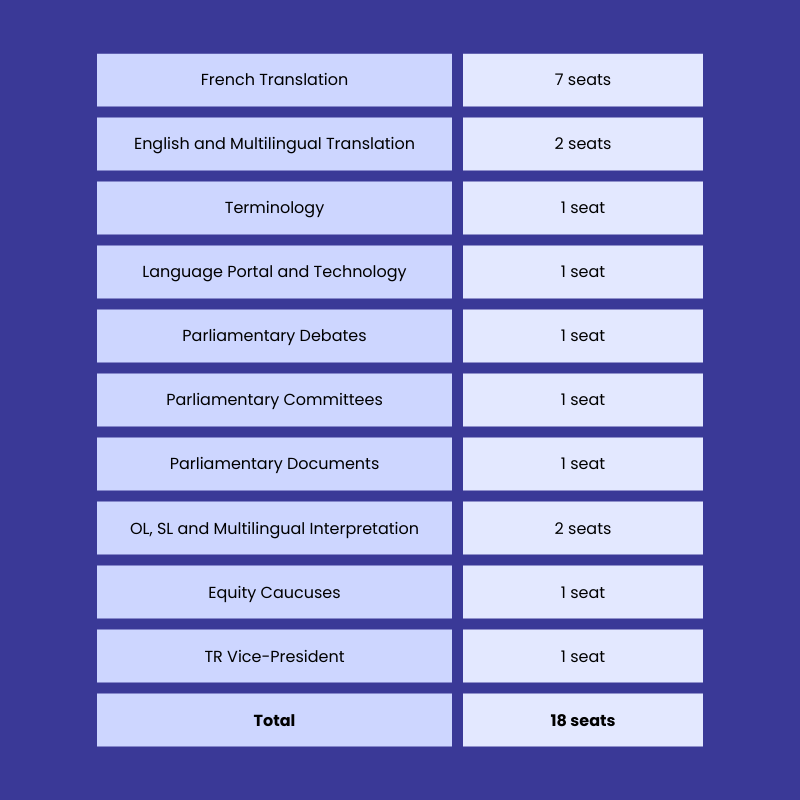
The TR bargaining team consists of 18 members.
The elections have now taken place. Members can find their elected bargaining committee departmental representative here.
The 18 members were elected based on where members work at the Translation Bureau:
Phase 3 – Ratification of proposals & vote on dispute resolution mechanism
The bargaining committee will work with staff, following their analysis of the results bargaining survey, to develop priorities and general proposals for negotiations. These priorities will be presented to all members at a series of Special General Meetings. There the bargaining committee will present the results of the survey and how they developed the proposals and priorities.
This is an internal ratification process before we sit down with the employer—it means that members participate again in high numbers to directly decide the union’s bargaining priorities during the vote. This is a new step in the process, as in the past members have only voted when the bargaining team and employer reached a tentative agreement.
The meetings will be an important moment for a membership-wide strategic discussion about what we need to do to make these gains. This is why, again with the goal of opening the door to more participation and democracy, we’ll hold a real vote on the choice between the strike/conciliation and arbitration paths in bargaining and not just bury it as a short question in the bargaining survey, before we even have a collective sense of what we want.
Immediately following the Special General Meetings, attendees will be able to vote online on both the bargaining proposals and to decide the dispute resolution mechanism.
The dispute resolution mechanism - conciliation or arbitration path
The federal public sector is an anomaly. Normally, unionized workers bargain and, when they reach an impasse, workers then decide to either go to arbitration or to take a strike vote to resolve things.
Unlike every other sector, federal workers have to decide how to resolve negotiations before they even start. The Federal Public Sector Labour Relations Act (FPSLRA) obliges workers to choose either the arbitration or strike/conciliation path before even meeting with the employer. Note that this is not a decision about whether or not to strike. It’s about if the option to strike is even available to you. An actual strike can only be called after a member-wide vote when negotiations have reached an impasse.
Why does this matter?
Arbitration path
Arbitration means that, in case of an impasse, a third-party arbitrator decides the contract. This decision is typically based on the arbitrator’s reading of norms and patterns on a given issue in the sector. With arbitration, you forfeit your ability to take legal job actions that could increase pressure on the employer in the case of an impasse. The decision of the arbitrator is final, binding, and usually excludes precedent-setting issues.
Arbitration basically awards an average based on other agreements. It cannot award new rights, like telework.
Before 2026, arbitration was sometimes a useful way to catch up to the sector’s average or to match gains made by other unions.
CAPE has always chosen arbitration and benefited by the gains made by PSAC. After every PSAC round of bargaining, CAPE members saw an increase in our wages and conditions because they raised the floor and set new standards for the federal sector. Compare our contract offer before and after PSAC went on strike – it’s night and day.
Unlike in past rounds, choosing arbitration does not mean we will follow the pattern set by PSAC (or PIPSC). Instead, it will likely mean worse conditions and probably lower wages. So, if we don’t want to take serious concessions in a highly politicized arbitration system, we need to build our own power and be ready to defend ourselves.
However, that change was not included in Bill C-15, the Budget 2025 implementation bill. Bill C-15 received Royal Assent on March 26, 2026, and the public summary of the bill lists other public sector measures, including early retirement measures connected to workforce reduction, but not a change to the FPSLRA arbitration rules.
That does not mean the issue is gone for good. Governments sometimes announce proposed changes in a budget and then do not include them in the first budget implementation bill. Sometimes those proposals are delayed, dropped, tested publicly, or brought forward later through another bill. The concern is that while this was not passed as part of the budget bill, the government could still introduce it in another bill this year or next year.
It is also important to know that arbitrators are already required under the current FPSLRA to consider several factors when making an arbitral award, including recruitment and retention, comparability with similar jobs, fairness based on the work performed, and “the state of the Canadian economy and the Government of Canada’s fiscal circumstances.”
Conciliation/strike path
Conciliation means that, in case of an impasse, a union keeps all options on the table including legal job actions like work-to-rule, slow downs, strike action, etc.
Choosing arbitration at the beginning, means you have little leverage at the bargaining table. It removes the option for conciliation, interest arbitration by mutual agreement and any legal job actions. Instead of actually negotiating, the employer just waits and sends the agreement to an arbitrator to decide.
If you want to win telework, protections against reckless AI, and better job security, that won’t happen in arbitration because arbitrators don’t award new rights. Instead, they usually award a contract that’s based on the average of what other similar unions have already bargained.
But just to be clear, the vote on choosing the strike/conciliation route or arbitration is not an actual strike vote—that would happen down the road in the bargaining process. Rather, this is a vote on the mechanism for resolving disputes—arbitration, or strike/conciliation. This will also be the first time that CAPE members get to vote on the dispute resolution mechanism.
So, if you want to win telework, improvements to WFA protections, and other new rights, you need to vote for the strike/conciliation path. We need leverage, and we need to prepare (with other unions) to maximize and use that leverage if need be.
CAPE is working closely with other unions like PSAC and PIPSC to align bargaining. We’re coordinating demands and timelines across bargaining tables. If we align priority demands and have each other’s backs, we’re not just 27,000 members — we’re close to 200,000 demanding improvements. That’s real leverage to win new rights.
You are very unlikely to win anything new or precedent-setting this way, like telework rights, because arbitrators usually do not award new rights. Instead, they usually award a contract that is based on the average of what other similar unions have already bargained.
Learn more about the General Meetings (May 28-June 9) and vote (June 10-17)
Phase 4 - Creation of Article Committees
The EC and TR bargaining committees will create sub committees for articles of the collective agreement that are most important to members. These Article Committees will be chaired by members of the bargaining committee, but open to all members in good standing in order to allow for maximum input on how articles should change.
Article committees will meet in the lead up to negotiations to prepare proposals. They will continue to meet on an ongoing basis throughout negotiations to respond to proposals from the employer.
Article Committees will allow for all members to participate in a deeper way and directly craft some of the proposals the bargaining team will bring to the table, especially for articles that have a direct impact on them. Previously, proposals were developed by the small, unelected bargaining team with staff, closed off from membership. The articling committees will also benefit from extensive staff support.
Phase 5 – Collective Agreements expire
The TR collective agreement expires April 18, 2026, and the EC collective agreement expires June 21, 2026.
On the union side, CAPE must give notice to bargain to the employer by these dates, including which dispute mechanism members have chosen (strike/conciliation or arbitration). Then CAPE begins scheduling meeting dates for negotiations. Since Treasury Board has a limited number of negotiators that negotiate with all unions, it usually takes a couple months before both CAPE and Treasury board first meet.
Phase 6 – Negotiations begin
In this phase, both parties meet and exchange their proposals. CAPE presents the changes that members have decided we need in our contracts, while Treasury Board presents the changes they wish to make.
This time, negotiations will be hybrid and open to all members to observe. Any member in good standing can virtually attend negotiations and observe the proceedings. The employer’s proposals will be shared with all members following the meeting, along with detailed updates.
CAPE’s bargaining committee and Treasury Board negotiators continue to meet over the coming months, first deciding on which order to negotiate proposals. Negotiation sessions happen several days at a time, followed by a gap of several weeks before meeting at the table again. This allows both parties to review proposals, to prepare additional information, and to suggest counter proposals.
And as the negotiations progress, every single member will be able to observe and participate in bargaining in some way.
Members will need to get involved in numbers never seen before by CAPE and take full ownership of this campaign.
The Organizing staff team will be there every step of the way providing guidance, training, and logistical support.
But fundamentally the action will happen in the workplace, between coworkers talking to one another about your workplace issues and how to bargain improvements in our working conditions.
There is only one step that you can take from here, and that's to join your Departmental Organizing Committee.
Join your Departmental Organizing Committee
CAPE will provide all the training and resources to get you started in systematically organizing your coworkers to fight back.
Staying up to date
Make sure your contact information is up to date and be sure to use your personal email address (because some departments block email and voting credentials - you will want to ensure you can vote without issues!) If you know of fellow CAPE members who aren’t receiving emails encourage them to register their membership with CAPE as well.