

Next steps for 2026-2027 Bargaining
This is a pivotal moment for CAPE members. This July, without any consultation, Carney’s government is forcing you back to the office four days a week, reducing your department’s capacity, and possibly cutting your job completely.
Fortunately, with bargaining starting in the fall, you can use your expertise, problem-solving skills, and strong voices to lean in and take it to the table – but you’re needed now to prep and plan. Bargaining is where CAPE members have the greatest ability to determine what your workplaces and your working lives look like.
This round of bargaining matters more than ever. This is your chance to decide what’s most important and take your issues to the table.
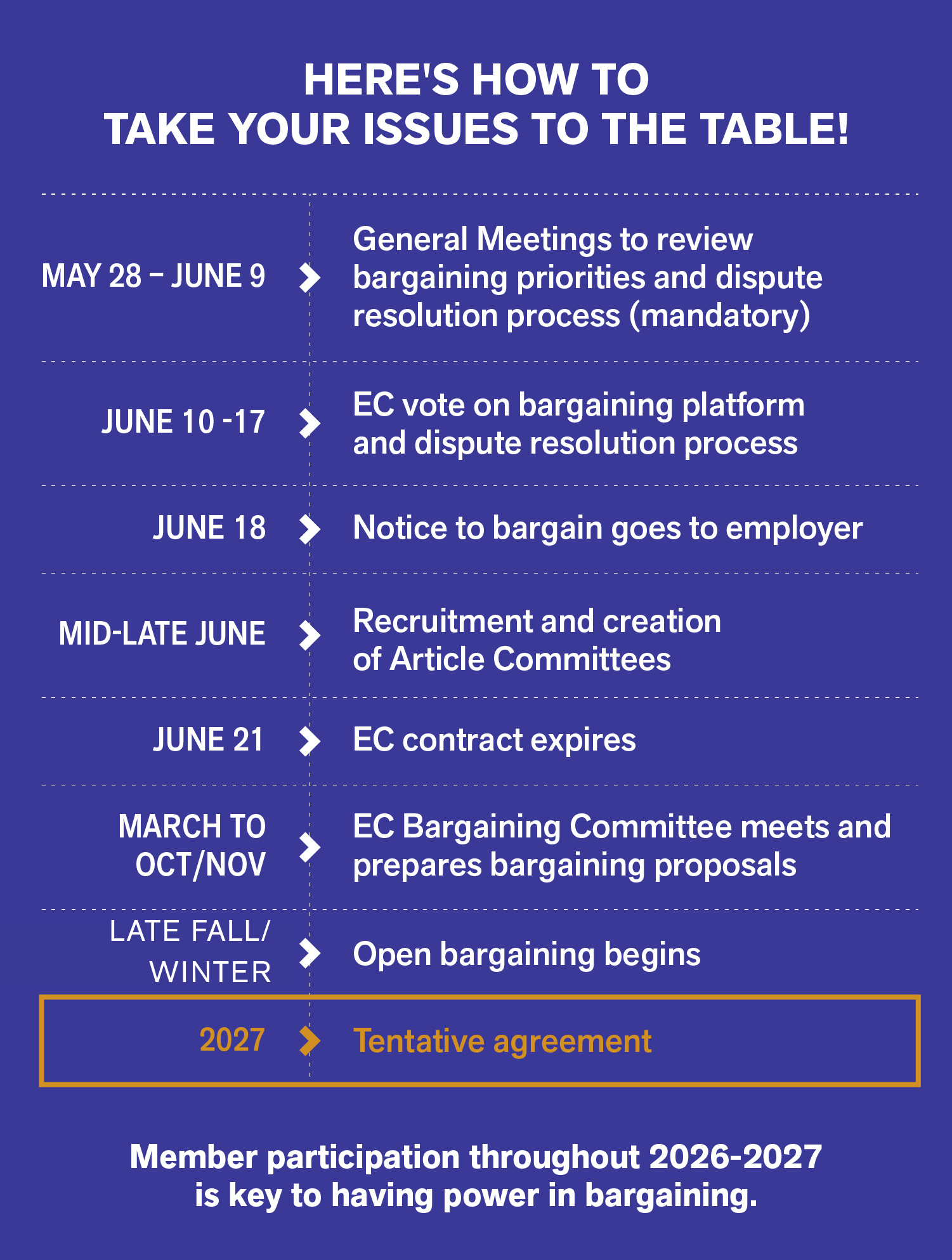
It’s official: the notice to bargain for the EC/ESS collective agreement was sent to the employer today, June 18th. This formally kicks off the bargaining process, and you are now headed to the table, with sessions likely starting in late fall/early winter 2026 and continuing into 2027. Your work is fundamental not only to programs and services across the government, but to the very functioning of Canada. You have the power.
Before the notice was sent, you voted (for the first time!) on your EC/ESS Bargaining Committee’s proposed bargaining platform and the dispute resolution mechanism for this round of negotiations.
ECs/ESSs have given a clear mandate and voted in favour of the EC/ESS bargaining platform and conciliation.
In the conciliation process, members keep the right to take legal job actions like work-to-rule, slow downs, strike action, etc. These options become available only after the parties reach an impasse at the table, go through the conciliation step (which produces non-binding recommendations), and members vote in favour to take job action. All bargainable issues stay on the table throughout the process — including new and breakthrough provisions. Also, under conciliation bargaining can be referred to arbitration if agreed to by the employer and the union. Check out the UPDATED Q&A page for more info on conciliation and next steps.
What happens now is very important for all EC/ESS members. We’re entering a tough round of bargaining. Carney is talking cuts and restraint while handing billions to corporate interests and illogically forcing workers back into the office. But with members like you involved, we can push back with real power and win stronger protections and new rights – like telework, WFA protection, and more. The EC/ESS Bargaining Committee will continue its work now that they have your vote of confidence.
Here are your next steps. These are important. Please read thoroughly then share with your co-workers.
- Join an Article Committee. Help develop new proposals that could change your working conditions! The time commitment is modest, but your contribution will make a meaningful difference at the table in 2026/27.
- Add the EC/ESS bargaining timeline below to your personal calendars.
- Talk to your PSAC and PIPSC counterparts about what’s at stake and how you can support each other in bargaining. The employer is counting on federal service workers to be divided. Building connections helps you build more power at the table.
Bargaining platform overview
EC/ESS members have now voted on the bargaining platform for the 2026–2027 round. Through this new open bargaining process, members had the opportunity to debate and vote on the priorities that will guide the EC/ESS Bargaining Committee at the table.
The EC/ESS Bargaining Committee developed these priorities using a range of information, including bargaining survey results, staff research, previous bargaining outcomes from CAPE and other unions, and the issues raised in thousands of conversations between EC/ESS members over the past year.
Here are the high-level workplace issues that CAPE members voted to guide the creation of the bargaining proposal package for the 2026-27 negotiations table:
- Flexibility in the Location of Work (Telework)/ Remote Work
- Leave
- Pay
- Job Security
- Work Life Balance
- Equity, Diversity and Inclusion
- Workplace Health and Safety/Appropriate Working Environment
- Technology
- Professional Development/Career Trajectory
These workplace issues are not presented in priority order or weightedness. If you’d like to be part of the process to win on these issues, get involved in the bargaining campaign and join the Article Committees.
These priorities will help steer the 2026–2027 bargaining round and ensure negotiations are focused on the issues EC/ESS members have identified as most important.
NOTE: A broad platform is not the same thing as an unfocused platform. It gives the elected bargaining committee a mandate to fight on the issues members have been raising across departments, while still allowing the committee to set priorities, develop demand language, and determine the path to winning. These issues are also connected: RTO affects accessibility, caregiving, commuting costs, health and safety, productivity, and cost of living; WFA is tied to job security, workload, contracting out, and AI; and wages are tied to inflation and the sustainability of public service work. A narrower platform may sound cleaner, but it can weaken the mandate before bargaining even starts. Treasury Board is not coming to the table with a narrow agenda, and members should not voluntarily narrow their own.
The dispute resolution process: EC/ESS members have chosen conciliation.
The federal public sector is unique because legislation requires a union to choose one of two dispute resolution paths before sitting down at the bargaining table.
EC/ESS members have now voted to use conciliation for this round of bargaining. This means that if CAPE and the employer cannot reach an agreement at the table, the dispute can move through a conciliation process and, if necessary, members may be asked to consider job action.
This choice gives members more collective power during bargaining and ensures that EC/ESS members remain central to the fight for a stronger contract.
2026-27 Bargaining Q&A
Updated
In the Canadian federal public sector, an impasse means the union and employer have reached a point in bargaining where they cannot get to a tentative agreement through negotiations alone. It’s when the parties cannot move forward with bargaining either because a party has no mandate or there’s no way to reach an agreement on issues.
It usually comes after multiple bargaining rounds of bargaining, exchanges of proposals, counterproposals, withdrawals, modifications, and attempts to narrow the issues, because bargaining is normally a back-and-forth process where each side tests priorities and trades movement on some demands for movement on others. Think about negotiating the price of a car or a house: you may not want to pay the asking price, so you’ll need to decide how many counteroffers to make and when to walk away.
In the conciliation route, either the union or employer can declare an impasse when they are unable to reach an agreement.
When the parties reached an impasse, and request conciliation, the Federal Public Sector Labour Relations and Employment Board (FPSLREB) can delay establishing a Public interest Commission (PIC) until they are satisfied that the parties have bargained “sufficiently and seriously". The Chairperson can encourage the parties to resume negotiations or work with a mediator.
In the arbitration route, if the parties cannot reach a tentative agreement, either party may ask the FPSLREB to establish an arbitration board, which issues a binding decision.
Under an open bargaining model, members will receive more regular updates about what is happening at the bargaining table than they have in past rounds of bargaining. CAPE’s goal is to make bargaining more transparent, participatory, and member-driven, while still protecting the bargaining team’s ability to negotiate strategically. This means members can expect updates on major developments, employer proposals, CAPE’s proposals, key issues under discussion, and moments when member action may be needed to strengthen the bargaining team’s position. Some details may still need to remain confidential during negotiations, especially when sharing them publicly could weaken CAPE’s leverage. But the overall direction is clear: members should not be left in the dark while decisions about their contract are being made. The exact way in which the updates will be sent to you and posted will be coming in the next few months.
The employer should not target, punish, intimidate, or treat members differently because CAPE is bargaining or because members are participating in union activity. Bargaining can sometimes make the workplace feel more tense. Managers may receive direction from Treasury Board or departments about communications, operations, or labour relations. But that does not give management the right to retaliate against members or interfere with lawful union activity. Your day-to-day rights at work still apply. The collective agreement still applies. Normal workplace rules still apply. If you experience pressure, threats, unusual scrutiny, discipline, or retaliation connected to bargaining or union participation, document what happened and contact CAPE.
Members have the right to participate in their union and in lawful bargaining-related activity. The employer cannot discipline, threaten, intimidate, or retaliate against members simply because they are members of CAPE, participate in union activity, vote, attend union meetings, support bargaining priorities, or exercise their rights. That said, members should make sure their participation is lawful and appropriate. For example, members should not engage in illegal strike activity, block access to workplaces, threaten anyone, misuse employer resources, or participate in union activity during working time unless they are on approved leave or otherwise authorized. If a manager threatens you, pressures you, discourages you from participating, asks how you voted, or treats you differently because of union activity, contact CAPE: representation@acep-cape.ca
The Rootham decision, involving the Alliance at Parliament, is an arbitral award that clarified some of the telework issues that can be negotiated. It has become an important reference point on telework. However, it unfortunately comes from a different jurisdiction than CAPE members. While that jurisdiction is similar to the FPSLREA framework, it is not exactly the same.
Open bargaining is a set of principles. Both the Treasury Board and bargaining agents have a legal obligation to bargain. The result of the dispute vote won't change that. Bargaining must proceed and CAPE has chosen to do it according to principles of open bargaining.
If the Treasury Board refuses to bargain because we have adopted open bargaining principles, then they run afoul of the law and the union has recourse, including filing an Unfair Labour Practice complaint. Both parties have to show an attempt to bargain in good faith.
There's a full spectrum of options for job action, from lightest to most significant:
- Work-to-rule is the lightest form and doesn't interrupt pay. Employees do their jobs exactly as outlined by contract or job description, precisely following all safety and other regulations. This causes a slowdown or decrease in productivity because workers are no longer working during breaks or unpaid extended hours (no checking email after hours, etc.). A great question to consider is, what would this look like for your department? With all the cuts and increased workload, would this be an effective tactic?
- Strategic strike involves 10% of the bargaining unit at a limited number of key locations designed to have the greatest impact on the employer's operations.
Example: in 2022 the BC General Employees' Union had a small number of workers picket at BC Liquor Distribution Branch warehouses, forcing liquor stores to ration sales — after two weeks the government returned to the table with a fair offer. - Rotating strike is a series of surprise work stoppages at strategic geographic locations, usually lasting one day. Members in Ontario on Monday, Quebec on Tuesday, and so on. Often used in the public sector — minimizes service disruption while keeping employers guessing.
- General strike is a full work stoppage by all bargaining unit members at the same time. This is what most people picture when they hear 'strike' — but it's one of many tools, not the only one.
As for how CAPE would decide to go on strike...
The collective bargaining committee would determine negotiations are at an impasse and cannot be resolved on their own. Then they would go through a non-binding arbitration process (conciliation) with the Public Interest Commission (PIC), which hears from both sides and makes a recommendation for how to resolve outstanding issues.
If an agreement still cannot be reached, the bargaining committee would then make a recommendation to the NEC and CAPE president to call for a vote of all bargaining unit members. A majority of all members of that bargaining unit would then have to vote in favor before a strike could be possible.
Again, a strike can involve a range of actions—for example, targeted activities in specific workplaces or a full walking off the job at sites across the country.
Keep in mind, a strike is the nuclear option. Choosing conciliation does not automatically mean CAPE will go on strike. Most unions negotiate their collective agreements on the conciliation path without ever taking a strike vote.
CAPE has been steadily rebuilding its defence fund since 2024. That year, members voted in favour of a special levy to increase the fund to $8 million. As an affiliate of the Canadian Labour Congress (CLC), the largest labour federation in the country, CAPE can also ask the CLC and its affiliates for a range of supports.
Should a strike vote ever take place, it would not happen for more than a year, leaving even more time to build up CAPE’s own funds.
As of now, CAPE National has not seen a confirmed change to the factors. However, because the government has signaled that it may seek to change or place greater emphasis on how fiscal considerations are weighed in arbitration or conciliation this year, it could still introduce such changes through another bill in 2026 or 2027—right as federal public service workers are bargaining. That uncertainty matters. It is another example of the employer creating confusion in a bargaining year.
More details:
In Budget 2025, the government announced that it intended to introduce amendments to the Federal Public Sector Labour Relations Act that would affect the collective bargaining dispute resolution framework. The budget language said public sector compensation should align with Canadian labour market trends and the government’s fiscal position.
However, that change was not included in Bill C-15, the Budget 2025 implementation bill. Bill C-15 received Royal Assent on March 26, 2026, and the public summary of the bill lists other public sector measures, including early retirement measures connected to workforce reduction, but not a change to the FPSLRA dispute resolution framework.
That does not mean the issue is gone for good. Governments sometimes announce proposed changes in a budget and then do not include them in the first budget implementation bill. Sometimes those proposals are delayed, dropped, tested publicly, or brought forward later through another bill. The concern is that while this was not passed as part of the budget bill, the government could still introduce it in another bill this year or next year.
Currently, CAPE is covered by the National Joint Council (NJC) WFA Directive until we negotiate a new process into the collective agreement. The Directive covers the process but it's full of gaps and those gaps hurt members at the moments that matter most. The NJC process is somewhat cumbersome and we decided to leave the NJC WFA Directive and negotiate our own, so CAPE members would be driving the changes they need.
Right now, SERLO decisions are employer-driven and subjective. If you are trying to alternate, for example, if the only available match is in a different region, you may be expected to relocate to take it.
PSAC bargains WFA protections directly into their collective agreements rather than relying solely on the NJC Directive — and they're bringing proposals to their tables right now. PSAC is proposing to prevent forced relocations and increase the use of remote work to prevent layoffs — so a geographic mismatch doesn't turn a job-saving option into a forced move.
PSAC's proposals fix the specific problems: equitable seniority-based SERLO, remote work as a tool to prevent forced relocations during alternation, better access to voluntary departure programs, and an education allowance increase from $17,000 to $25,000.
The PSAC WFA Agreement is separate from the NJC WFA Directive — so improvements they win at their tables don't automatically flow to us. But it shows what's possible when unions bargain WFA directly. We can do the same at our table. To get there, we need leverage.
If Treasury Board advises CAPE that it believes some positions in the bargaining unit are necessary to provide essential services during a strike, CAPE and Treasury Board must negotiate an Essential Services Agreement, or ESA. An ESA identifies the positions needed to maintain services that are necessary for the safety or security of the public during a strike. An ESA must be in place before the bargaining unit can be in a legal strike position. This process can affect the bargaining timeline. The length of the delay depends on how many positions Treasury Board proposes to designate, how complex the discussions are, and whether CAPE and the employer can reach agreement or need unresolved issues sent to the Federal Public Sector Labour Relations and Employment Board. Once an ESA is in place, the law also requires additional time to pass before a legal strike can occur. If your position is designated essential, you will be notified in writing. If a strike happens, you would be legally required to report to work during your designated hours, and you would not be able to participate in strike activity during those working hours. Being designated essential does not mean you are cut out of bargaining. Essential workers are still members of the bargaining unit. They can still receive bargaining updates, attend meetings, vote where applicable, talk with coworkers, support bargaining demands, and participate in lawful bargaining actions outside their designated hours of work. Under an open bargaining model, CAPE will keep members updated throughout the ESA process, including what it means for timelines, member participation, and any actions members can take to strengthen the bargaining team’s position.
There is no path where concessions are impossible. No matter which dispute resolution process members choose, the employer will likely come to the table looking for concessions, and CAPE will have to fight to protect members’ rights, working conditions, and wages. The difference is not that one path guarantees losses, and the other prevents them. The difference is where your power comes from. Under conciliation, members keep more collective leverage. If the parties cannot reach a deal, conciliation can lead to job action, but only if members vote for it. That does not mean a strike is automatic. It means members preserve the ability to increase pressure on the employer if needed. That pressure can be an important tool for resisting concessions and pushing for stronger gains. So, the question is not simply, “Which path has fewer risks?” Both paths carry risks. The question is: Which path gives members the best chance to build power, push back on concessions, and win the strongest possible agreement CAPE’s position is that member participation will be critical either way. The stronger and more organized members are, the better our chances of resisting concessions and winning improvements at the table.
No. Choosing conciliation does not mean members are definitely going on strike. It also does not replace a strike vote. Choosing conciliation means that if bargaining reaches an impasse, CAPE keeps a wider range of tools available to put pressure on the employer. Those tools can include legal job action, but only if the required legal steps have been completed and members vote in favour of a strike. A strike is not automatic. It is one possible tool, and usually a last resort. The goal is still to reach the strongest possible agreement at the bargaining table. Here’s a list of all the possible job actions CAPE members can take with the EC/ESS Bargaining Committee leading on how you choose any of the options if needed: Work-to-rule, overtime refusal, overtime ban, slowdowns, refusal of extra duties, coordinated breaks, coordinated lunch actions, petitions, open letters, member pledges, rallies, demonstrations, picketing, rotating strikes, targeted strikes, full strike, public pressure campaigns, solidarity actions, etc.
If there is a legal strike and you withdraw your services, you would not be paid by the employer for the time you are on strike. That time would generally be treated as leave without pay and deducted from a future pay cycle. If members ever reach the point of a strike vote, CAPE would provide more detailed information about strike pay, benefits, essential services, accessibility needs, accommodations, and different ways members can participate. It is also important to say clearly: participation can look different for different members. Some members may face serious financial, medical, caregiving, disability-related, or accessibility barriers. CAPE’s goal would be to make any collective action as accessible and sustainable as possible, and to ensure members understand their options before any strike vote takes place. Members who are designated essential, excluded, unrepresented, or otherwise not legally permitted to strike must report to work as directed. They may still be able to support bargaining in other ways, including outside their scheduled working hours.
Under conciliation, members’ power comes from collective pressure. Conciliation keeps more options on the table if the employer refuses to move. That can include public pressure, workplace organizing, coordinated member action, work-to-rule, strategic or rotating strikes, or a broader strike — but only if the legal requirements are met and members vote for that step. This matters because some issues are hard to win through arguments alone. Issues like telework, workload, AI protections, job security, and stronger worker voice may require visible member support and pressure outside the bargaining room. Conciliation gives members more leverage to push back against concessions and fight for a stronger agreement.