
On September 10, 2025, CAPE hosted a debrief of the RTO petition campaign and shared results, analysis, and next steps with participants.
If you missed the session, grab a cup of tea and read more about the plan to win on telework and your role in this effort. Most importantly:
- Join your departmental organizing committee or form one in your department in order to win telework in our next collective agreement.
Session summary
At the session, members discussed how we are still being impacted by RTO—from workplace conditions and a lack of space, health and safety concerns to the ongoing costs of commuting and the impacts it has on work-life balance and overall productivity.
We also discussed how RTO isn’t just about long commutes and bad overhead lighting; it's also deeply interrelated with budget cuts and workforce adjustment.
The employer could save $2 billion a year by getting rid of unnecessary office space which could be put to uses that actually benefit society, like childcare and housing.
And RTO was never about productivity – a report from Statistics Canada showed us that public servants are actually more productive with the flexibility of remote work.
This means the employer could be saving billions and prioritizing keeping good-paying Canadian jobs, benefitting from a more productive workforce and reducing our ecological footprint by granting full-time remote work for those that want it.
During the session we also reviewed outcomes from the national campaign and the departmental RTO petition results.
Next, we covered the plan to win telework and the timeline for open bargaining and your role in it.
In short, if you want remote work, you need to win it in your contract—that means building serious leverage and being prepared to use it.
National campaign
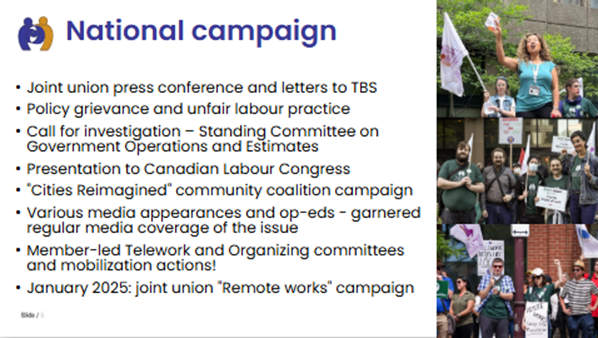
The session recapped the efforts on behalf of CAPE at the national level, including:
- Various media engagement campaigns
- Advertising campaigns
- Formal labour relations complaints
- Alliance-building efforts with allied federal public sector unions and the wider Canadian Labour Congress
- Community coalition efforts
- Rallies and public events
- The launch of the national Telework Rights Working Group,
And while ad campaigns, media coverage, formal mechanisms like the policy grievance and unfair labour practice complaint, and community coalitions are important work, those alone will not win on telework.
If we have any hope of winning telework, it must come from building collective power to use at the bargaining table.
Telework Rights Working Group
In May of 2024, CAPE launched the Telework Rights Working Group, a cross-departmental working group of rank-and-file CAPE members aimed at building a grassroots member-driven campaign to secure remote work for all public servants. Several hundred CAPE members participated in virtual strategy meetings at the national and regional level.
During these meetings, CAPE members directed the creation of a national strategy on telework by designing a ladder of escalating tactics, selecting targets on whom to apply pressure, a public awareness campaign, and plans around campaign implementation.
The working group determined that the telework campaign should be directed at the local level with organizing committees struck to advance that work, and that the campaign would begin with a petition demanding an exemption to in-office presence directed towards Deputy Ministers across the federal government.
The work of the Telework Rights Working Group therefore shifted from the national to the local level with the creation of local organizing committees.
Local Organizing Committees
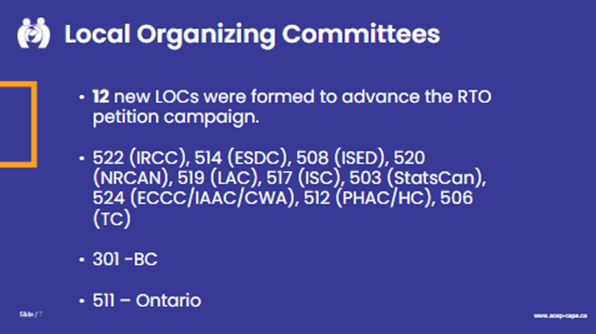
Throughout the summer of 2024, 12 local organizing committees were formed and picked up where the national Telework Right Working Group left off, namely, to advance the RTO petition campaign.
These LOCs worked hard through the summer and fall of 2024 and into winter 2025 to gather signatures on their departmental RTO petitions by canvassing their workplace, organizing calls with coworkers outside of work hours, holding virtual townhalls as well as information pickets and rallies outside their physical workplaces.
Organizing committee members massively increased union participation in many of our departments, bringing conversations about workplace issues into our teams and having open, frank discussion about what we want to change as ECs for the very first time.
Petition results
The RTO petitions were designed to be majority petitions, meaning they would only be delivered once a clear majority, 50% +1 of ECs in a department, had signed before it would be delivered to the deputy minister.
And while there are currently no RTO petitions that have reached this threshold (many came close), what’s clear is that departments that had local organizing committees actively driving the petition had significantly higher participation results than departments that didn’t have local organizing committees.
Across the full CAPE membership, 20 per cent of CAPE members signed their RTO departmental petitions.
Justice Canada, Immigration, Refugees and Citizenship Canada as well as Employment and Social Development Canada came away with the largest percentages of their departments signing the RTO petitions.
Organizing committees massively increased participation, upwards of 20 percentage points in some cases compared to departments that didn’t form one.
The departments with the lowest petition results have signatures only from the national email campaigns and web links on the CAPE website.
What this demonstrates is that without an organized body of coworkers systematically reaching out and talking to each other, we will not be able to build the kind of supermajority we will need to win telework at the negotiating table. Emails alone will not build power.
While the campaign did not meet its stated goal of reaching a majority on a petition and overturning the RTO mandate, two important lessons emerge:
- When members are given the tools to run organizing campaigns, they can massively increase union participation; and
- This demonstrates that RTO was and remains a widely and deeply felt workplace issue for a sizeable percentage of CAPE members.
Workplace campaigns like the RTO petition can be a long road filled with unclear outcomes and half-victories that must be analyzed and built upon. And what's clear is that we are stronger going into bargaining thanks to this campaign.
Assessing opportunities and threats to win on telework
The current Letter of Agreement between the employer and CAPE, as well as the Directive on Telework and the Prescribed Presence in the Office, are totally insufficient to secure members' a right to telework agreements that work for them.
For instance, the Letter clearly states that "Telework is not a right or an entitlement of the employee unless agreed upon in connection with the duty to accommodate" and even then, we've seen the employer brazenly denying reasonable requests for accommodations.
This means that the lesson is quite simple: You and your coworkers will need to secure break-through language on telework in your next contract if you want more work-life balance, more time with family and friends and less needless pollution.
Let's be clear, CAPE members want remote work – and we should, especially when it would save so much money in this artificial deficit crisis the Liberals are threatening our jobs over.
And in the current climate of budget cuts, WFA, and austerity, it's going to take everything we collectively have to stave off concessions and bargain new rights. Including being willing and ready to strike.
In negotiations, if we take the arbitration route of resolving disputes at the bargaining table, we might as well just give up on improving our rights to telework. It’s a new right, and arbitrators don’t award new rights in collective agreements – so you need to have actual leverage, not just good arguments.
Organizing is how we get that leverage.
In order to secure strong language in your next contract, you need to start organizing now. That means talking to coworkers and taking action to maximize our power in bargaining next year.
That starts by joining your departmental organizing committee and getting ready to win telework in the next round of bargaining. To win big you will need to talk to coworkers and build power in your workplace.
Plan to win: Open bargaining
Open bargaining is a collaborative, member-driven process that dramatically increases rank and file participation in negotiations. It replaces closed-door discussions with open, democratic engagement, where members help shape proposals, sit at the bargaining table, and directly influence bargaining strategy.
And we're doing it differently this time— we're going to bargain openly, transparently, and in a way that is fundamentally driven by members.
To win telework rights, our strength at the table depends on how much collective power we’ve built – not good arguments, or evidence, or moral claims or appeals.
It will entirely depend on how much CAPE members (and PSAC and PIPSC members) are willing to fight for it.
Unions that adopt open bargaining routinely secure some of the strongest contracts in their sector, not just on wages, but on groundbreaking workplace protections and new rights for their members.
To learn more about open bargaining and read some fascinating case studies, check out Rules to Win By, by Jane McAlevey and Abbey Lawlor.
Open bargaining timeline
The very first step for CAPE members is the bargaining survey which will be launched in late November and Organizing Committees will be asking members to fill it out. This is your chance to say what gets brought to the bargaining table.
Then departments will elect representatives to sit on the bargaining team.
Elections will happen in early 2026.
In the past, only about 20 per cent of CAPE members filled out the bargaining survey. To build power in bargaining, we need to rapidly scale up member engagement. And past survey rates show that emails will not cut it. In order to show Treasury Board that a majority of CAPE members demand telework, you will have to bring the survey to your whole team and get them to fill it out.
Then, next spring, in April 2026, all members will have the opportunity to vote on the proposals that CAPE brings into negotiations. This is an internal ratification process before we sit down with the employer—it means that members participate again in high numbers to directly decide the union’s bargaining priorities during the vote. This is a new step in the process, as in the past members have only voted when the bargaining team and employer reached a tentative agreement.
Concurrently, members will also vote on the dispute resolution mechanism. This is essentially the way in which the union will resolve disputes at the bargaining table in the event of an impasse.
In the past CAPE has decided to go straight to arbitration to resolve disputes, rather than opt for the strike/conciliation path.
However, if you want to win telework, that won’t happen in arbitration as arbitrators don’t award new rights. Instead, they usually award a contract that’s based on the average of what other similar unions have already bargained.
But just to be clear, the vote on choosing the strike/conciliation route or arbitration is not an actual strike vote—that would happen down the road in the bargaining process. Rather, this is a vote on the mechanism for resolving disputes—arbitration, or strike/conciliation. This will also be the first time that CAPE members get to vote on the dispute resolution mechanism.
So if you want to win telework, you need to vote for the strike/conciliation path.
And as the bargaining team gets going and formal negotiations are underway in Fall of 2026, every single member will be able to observe and participate in bargaining in some way.
Members will need to get involved in numbers never seen before by CAPE and take full ownership of this campaign.
The Organizing staff team will be there every step of the way providing guidance, training, and logistical support
But fundamentally the action will happen in the workplace, between coworkers talking to one another about your workplace issues and how to bargain improvements in our working conditions.
There is only one step that you can take from here, and that's to join your departmental organizing committee.
Solidarity,
Nathan Prier
President, CAPE