
You’ll need a valid password to vote on the budget and the dues November 17–28. Click here to update your password, or register as a CAPE member if you haven’t already; registration processing time can take up to 48 business hours.
This year’s budget includes a proposed dues increase. It isn’t just a number; it’s an investment by members in the strength of our union and in our ability to win the protections and improvements we all need.
Take some time to review the information provided, including the Budget Document (document will open in your downloads) and presentation, as well as an FAQ on the dues increase proposal.
The complete budget and proposed dues increase, along with the audited financial statements for 2024, will be presented at our annual general meeting on November 16.
>>Voting period from November 17 to November 29, 2025
The voting period will begin following the AGM. Pursuant to CAPE’s Constitution and Bylaws, members in good standing will be asked to vote for the resolutions being put forward, and to approve the association’s financial statements and the budget.
>>Be sure you're registered to vote
Make sure you can log into the membership portal without any issues to make it quick and easy at voting time! TIP: Use your personal email for your account – it’s better for spam filters than work emails. Contact membership@acep-cape.ca for assistance.
>>FAQs
A. Details on proposed increase
- What exactly is the dues increase proposal?
Beginning July 1, 2026, CAPE’s dues and defence fund contributions shall be set at:
- 1.0% of a member’s regular salary, based on the first step of their classification
- 0.9% of the member’s regular salary (90% of dues collected) to be allocated towards CAPE’s general revenues
- 0.1% of the member’s regular salary (10% of dues collected) to be allocated towards the CAPE Defence Fund
- 1.0% of a member’s regular salary, based on the first step of their classification
Monthly dues shall be capped at $90 per month starting on July 1, 2026, increasing to $100 on July 1, 2027, and $110 on July 1, 2028. Most members will be paying significantly less than the cap.
Dues shall be decreased by 50% for members working on part-time status, either directly on the member’s pay (subject to the confirmation of ability to implement from the pay centre) or via an annual rebate from CAPE.
Dues rates shall be adjusted on the first day of the month following a wage increase and shall be rounded down to the nearest dollar.
2. What will the dues increase look like for my pay level?
Currently, dues for all CAPE members are $61.33 per month, including the special levy for the Defence Fund in 2025, or $48 per month excluding the special levy.
The table below shows dues rates for each classification and level, as of July 1, 2026 (when the dues increase would go into effect) and July 1, 2027. This assumes that no new collective agreement is signed before July 1, 2027, which, given the history of federal public service bargaining, is a safe assumption. Dues rates in 2028 will depend on if a collective agreement is signed by then, and on the wage increases in that collective agreement.
Dues rates can be calculated by taking the step 1 annual salary for a classification, multiplying by (1/12) and then by 0.01, then rounding down to the nearest dollar. If this number is above the monthly cap, then the cap applies.
Jul-26 | Jul-27 | ||
EC | EC-01 | $ 52.00 | $ 52.00 |
EC-02 | $ 58.00 | $ 58.00 | |
EC-03 | $ 64.00 | $ 64.00 | |
EC-04 | $ 69.00 | $ 69.00 | |
EC-05 | $ 83.00 | $ 83.00 | |
EC-06 | $ 90.00 | $ 94.00 | |
EC-07 | $ 90.00 | $ 100.00 | |
EC-08 | $ 90.00 | $ 100.00 | |
TR | TR-01 | $ 56.00 | $ 56.00 |
TR-02 | $ 61.00 | $ 61.00 | |
TR-03 | $ 75.00 | $ 75.00 | |
TR-04 | $ 82.00 | $ 82.00 | |
TR-05 | $ 90.00 | $ 100.00 | |
LoP | AWL-01 | $ 58.00 | $ 58.00 |
RAN-01 | $ 63.00 | $ 63.00 | |
RAN-02 | $ 77.00 | $ 77.00 | |
RAN-03 | $ 84.00 | $ 84.00 | |
RPR-01 | $ 90.00 | $ 95.00 | |
RED-01 | $ 77.00 | $ 77.00 | |
RSO-01 | $ 68.00 | $ 68.00 | |
OPBO | BAW | $ 53.00 | $ 53.00 |
BAN | $ 59.00 | $ 59.00 | |
BAN-02 | $ 72.00 | $ 72.00 | |
BAN-03 | $ 79.00 | $ 79.00 | |
BAA | $ 86.00 | $ 86.00 | |
BAA-02 | $ 90.00 | $ 100.00 |
3. What are the expected revenues of this dues increase?
Dues restructuring would go into effect on July 1, 2026. Average dues will increase to approximately $73.50 in 2027, of which approximately $66.25 would go to CAPE’s general revenues and $7.25 to the Defence Fund. This increase is projected to bring dues revenue to $19.3 million in 2026 and $23.1 million in 2027, increasing to $24.7 million by 2030, excluding Defence Fund contributions[1].
| 2026 | 2027 | 2028 | 2029 | 2030 |
Dues - General Revenues | $19,255,000 | $23,135,000 | $24,052,000 | $24,622,000 | $24,709,000 |
Defence Fund (DF) | $1,281,000 | $2,571,000 | $2,672,000 | $2,736,000 | $2,745,000 |
Total dues revenue: | $20,536,000 | $25,706,000 | $26,725,000 | $27,358,000 | $27,454,000 |
Avg. Dues per member | $54.10 | $66.32 | $70.33 | $73.45 | $75.21 |
Avg. DF per member | $6.01 | $7.37 | $7.81 | $8.16 | $8.36 |
Avg. Dues + DF per member | $60.11 | $73.68 | $78.14 | $81.62 | $83.56 |
What will the dues increase be used for?
This is primarily an investment in CAPE’s leverage to win on the issues that matter most to us – whether in our collective agreement and/or in public campaigns. This investment will include:
- Union leave (salary recovery) to directly organize your coworkers through local organizing committees, open bargaining committees, and CAPE campaigns and where applicable.
- Our ability to face down a hostile employer and secure gains for our future, such as remote work rights, depends on our tested level of unity and discipline, which requires a systematic organizing approach so we can build power and leverage. As we are likely to want new rights in the collective agreement, which arbitration by definition cannot win, we will need to be in a strike position if we credibly want to fight and win things like remote work rights
- Union leave (salary recovery) for local executives to support the development of locals.
- The demands of running a local can be immense: from supporting members, to managing local finances, meeting with labour relations officers, meeting with the employer, coordinating responses with other local union executives, handling local governance, and much more. Currently all the work of setting up and managing a CAPE local is done without union leave, unlike most other unions. The new dues model will allow for us to offer small amounts of union leave per month to local leaders to support the growth of locals and foster greater member engagement.
This also adds staff-side support to CAPE’s organizing department to support this historic member-led leverage buildup.
- Research and negotiation staff to support a dramatic increase in member involvement in bargaining, as well as strategic research support so CAPE’s campaigns can be as effective as possible.
- Increasing professional labour relations support as members are increasingly impacted by workforce adjustment and unhealthy workplaces.
- Training and education investments as CAPE‘s education demands skyrocket with record levels of member engagement, and to ensure training resources are in place as CAPE increases representation capacity by allowing, for the first time, stewards to handle grievances.
Building up a strong defence fund, which CAPE has significantly underfunded for years. Investing now will give us far more capacity to use the leverage we build through organizing by having a credible strike fund.
CAPE’s dues would finally be able to keep up with inflation and membership growth pressures, while building the leverage for CAPE to pull our own weight in the federal public sector labour movement and win the best contract we’ve ever won.
The new proposal would still see CAPE have the lowest dues of the main federal public sector unions, but would dramatically increase investment in your ability to win the things you want, need, and deserve.
How did the NEC develop the dues increase proposal?
In 2024, NEC members were presented with a report on CAPE’s finances and dues structure. Following receipt of this report, members of the NEC analyzed multiple different models – a flat rate, a percentage structure, and a hybrid structure. They concluded that a percentage-based dues structure, which is what most other unions use, was the fairest and most sustainable of these options. Both CAPE’s finance department and the employer’s pay centre were consulted to ensure that such changes could be implemented.
We are entering into bargaining for CAPE’s largest groups with new rights, like remote work, likely to be core demands – while at the same time, deep cuts are threatened across the federal public service. It was determined that a significant investment in member-led organizing and training was needed to build up the leverage necessary to win, while building out critical infrastructure like a credible strike fund, strategic research depth, and quality professional labour relations support.
A financial analysis was done to determine the costs associated with the above and calculate a target revenue for the dues restructuring. Dues rates in this proposal were set to achieve this target revenue within the next three years.
Similar analysis and comparison with other unions was also done to determine the defence fund contributions required to support CAPE members during any labour dispute and therefore have a credible strike threat.
Why the split with the defence fund? Didn’t we just top it up?
The CAPE Defence Fund was established following a membership vote in 2016. The primary use is to support job action in bargaining if needed. Unlike other unions, CAPE does not have a set formula to allocate funds to the defence fund and has traditionally funded it by allocating 75% of any budget surpluses towards it.
The defence fund was capped at $5 million in 2022, reducing its value by approximately $4 million. In 2024, the membership voted for a temporary special levy, in addition to dues, to partially replenish the defence fund. This was only for part of 2025. It does not continue to add to the defence fund on an ongoing basis.
CAPE’s current defence fund levels would only allow for us to strike, if that was necessary, for three days. We need to aggressively fund our ability to take job action in this round, if we are serious about issues like remote work that cannot be won through arbitration. As Canadian Labour Congress affiliates, we can request support in the case of a job action, but only if we are seen as taking our own self-defence seriously.The current proposal of the dues increase includes 0.1% of the member’s regular salary, or 10% of dues collected, to be allocated towards CAPE’s defence fund so that regular investment in CAPE’s critical infrastructure is institutionalized.
B. Why a dues increase is needed
1. Key economic elements
- CAPE’s membership dues are the lowest in the federal public service compared to the other major unions
- CAPE’s dues have not increased since 2014
- CAPE has introduced special levies to support some initiatives
- CAPE’s membership has doubled since 2017: From 13,773 in 2017 to 27,137 in 2023 which has also necessitated increased hiring of CAPE staff to serve members
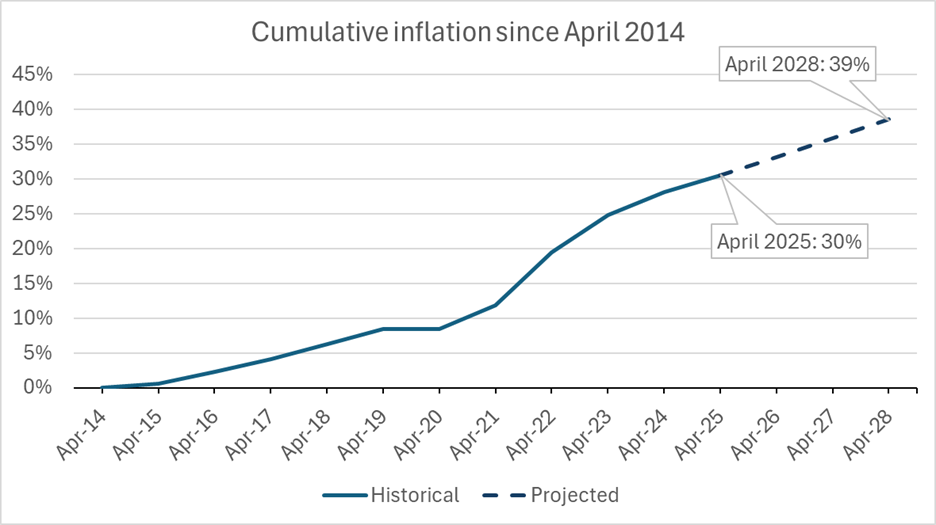
Cumulative inflation, which applies to most CAPE spending, was 30% between April 2014, when CAPE’s dues were last increased, and April 2025. Cumulative inflation is expected to reach nearly 40% by April 2028. The dues paid by CAPE members have not changed since 2014.
Graph 1: Inflation since CAPE’s last dues increase
2. The political necessity
CAPE members are facing serious threats, including:
- Deep cuts to public services and programs
- Austerity beyond attrition. The government has mandated 15% cuts across the board, before tabling a budget
- Expansion of unproven AI tools, with the explicit goal of reducing jobs
- Workforce adjustment initiated across many departments
- A difficult round of bargaining ahead, as we face a government intent on steep budget cuts
All of this requires investing in our collective capacity. If we do not strengthen our capacity to respond to these threats, we will lose leverage and bargaining power – not just in this round, but in future rounds. Any concessions or rights lost now will be harder to recover in the future.
In recent years, we’ve seen organized and disciplined groups of workers defy anti-union employers and governments and win through the collective power that they have built.
- Ontario education workers in 2022 rolled back back-to-work legislation, overturning the government’s use of the notwithstanding clause.
- Air Canada flight attendants ignored federal back-to-work legislation to force Air Canada back to the bargaining table and won ground pay after the employer refused to give it to them and relied on the federal government to force them back to work.
We can win on the issues that matter to us – issues like protecting our jobs from workforce adjustment or winning remote rights – but only if we build our own power. To do that we need a properly funded union that has the resources for training and organizing.
Winning also requires stable, ongoing funding to our defence fund so we have a credible strike threat. We can not win new rights by relying on arbitration and hoping that other unions achieve breakthroughs without us. A strong defence fund – and one that has a stable source of ongoing funding – allows us to have a credible strike threat and more leverage at the bargaining table.
3. A permanent fix
CAPE’s current dues formula is a flat rate and not indexed to inflation, which requires a referendum of the entire membership to even increase dues to match inflation. This is financially unsustainable in the long term. Under the current formula, CAPE’s revenues per member are constantly declining in real terms. This further creates tension and division among the membership as large dues increases are required to be voted on after several years of inflationary pressures just for dues to keep pace with rising costs.
Other unions have a dues formula that is based on a percentage of the wages or salaries of members. This means that with a constant percentage, dues revenues increase with each salary increase that members receive, automatically indexing revenues to member salaries.
If we do not adopt a percentage-based formula, it could threaten CAPE’s ability to represent members and engage in collective bargaining and our capacity to play our role as the third-largest federal public service union and impact
Switching to a dues model of 0.9% of salary will permanently fix this situation. It will provide a sustainable flow of resources to adequately meet rising costs, while strengthening our capacity to do and win more. Further, setting defence fund contributions at 0.1% of salary will ensure a healthy and permanently growing defence fund that expands what we can win in negotiations.
- What if this proposal does not pass?
This year’s budget proposal is very clear about the investments being made to increase our leverage on our key campaigns and in collective bargaining. Without a dues increase to support those investments, CAPE will need to draw from its operating funds to prepare for bargaining and collective action.
It’s time for CAPE to pull our weight and not wait for unions that built leverage – like PSAC – to secure wins at the bargaining table. That means bringing our investment in building leverage up to normal union levels.
If this proposal does not pass, then CAPE will continue to be trapped in an unsustainable dues formula. Revenues in real terms will decrease as they are not indexed to inflation, at a time when demands for service are likely to increase and an investment in the union is required to defend our rights and win in bargaining.
- When was the last time dues were increased?
The last time the dues were increased was 11 years ago, in 2014, when the members voted in favor of a $13/month increase. There have been multiple dues increase votes put to the membership in the years since, but they have not passed. Didn’t we have a dues increase in 2025?
No, there was a special levy applied for part of 2025 which members voted for as part of the 2024 AGM to replenish the Defence Fund. More information can be found on the website. This was a temporary increase in fees to be applied solely to the defence fund and not to operational expenses.
By what percentage have dues revenue increased since 2018?
Dues revenues have increased by 88% from 2018 to 2024. However, this was entirely due to growth in CAPE’s membership, as the total number of members grew by more than 12,000 over this period. With that growth in membership also came increased demands for services and increased costs to CAPE.
Given the austerity agenda of this government, CAPE can no longer rely on membership growth for increased revenue to offset rising costs.
Why are you proposing a change to the dues structure? Why a percentage model?
Most other unions use a percentage formula for dues, where dues are generally 1-2% of regular wages. The reason that the majority of unions use a percentage model is because it is more equitable and more sustainable.When it comes to income tax, we know that a flat tax on everyone, regardless of their income, simply does not make sense. Currently, the lowest paid CAPE members pay the highest rate of union dues;
In addition to being fairer, a percentage-based formula allows dues to be automatically indexed to members’ wages and keep their value in line with inflation. And when you win a salary increase in bargaining, salaries increase by a percentage.
CAPE’s current flat dues structure has meant that our current dues rates have lost around 25% of their real monetary value since our last increase due to inflation and will continue to lose value going forward.
Will changing the dues structure mess up our pay in Phoenix?
No, this proposal was designed with implementation in mind and is similar in structure to other unions such as PSAC. This is why the proposal has been adjusted from a pure percentage model, and why it is to go into effect on July 1, 2026, to give six months for Public Service and Procurement Canada to complete the testing of this new formula and ensure that everything is functioning as it should.
How does this compare with other unions?
CAPE’s dues rate would continue to be the lowest of the large federal public sector unions, and near the lowest among Canadian unions. Dues for PSAC vary depending on a member’s component and local but are generally in the 1.5%-2% range. PIPSC uses a flat rate of $90.06/month, while on average, CAPE’s dues would be approximately $73.68/month in 2027.
Outside the federal public service, most unions charge from 1-2%. CAPE’s proposed 1% total dues rate would be identical to AMAPCEO, the union with the lowest dues rate in the analysis presented to the NEC in September 2024.
The following table presents a comparison between CAPE’s proposed new dues structure and that of other public sector unions in Canada:
Unions | Membership count | Current rate per month or % | Adjustment | Examples of values in $ |
CAPE (Proposed) |
27, 655 | 1% |
Resolution of the AGM (whole membership votes) |
Approx.$73.50 (average in 2027) |
ACFO (Federal public services)
|
7,000
| $73.18
| Resolution of the AGM
CPI adjustment April 1st of each year | $73.18 |
PIPSC (Federal employees) |
70, 000 | $90.06 | Resolution at the AGM (delegates) | 90.06$ |
Association of Justice Counsel (Federal employees) |
3,500 | 1.25 % of annual salary
| Resolution at the AGM Linked to salary adjustment | 104.85$ to 256.75$ for LP category |
National Police Federation (RCMP Officers) | 20,000 | 1,75% of salary | Linked to salary adjustment | 145,83$ [2] |
Canadian Union of Postal Workers | 54,000 | 1.71% of the wage to a monthly maximum equal to the dues for Urban Operation members | Resolution at the AGM
Linked to salary adjustment (with a monthly maximum) | Max: $95.14
|
OPSEU (Ontario public services and other)) |
180, 000 | 1.375% of the gross salary[3] | Resolution at their annual delegated convention
Linked to salary adjustment | 66,66$ to 76,87$ for pharmacy technician category[4] as an example |
AMAPCEO (Ontario public services) | 16,500 | 1% of gross salary | Resolution at the AGM
Linked to salary adjustment | 80.97$ to 93.80$ for actuary category[5]
|
PSAC
| 240,000 members, most of them in Federal public services | Percentage: Central: 0.9617%+ Component 0.6196%[6]+ for directly chartered components Strike fund $2.20
| Resolution at each Triennial Convention (Central and component) Changes to the % can occur
| 52.33$ to 180.46$in PM category[7] |
International Brotherhood of Electrical Workers (IBEW)
|
70,000, including 1800 working for the federal public service |
IBEW members who work for the federal government pay a flat rate based on their employment level
$95.40-$182
| Local dues are set by a vote of the membership
| $95.40 to $182 per month |
Fédération interprofessionnelle de la santé du Québec |
80,000
|
1.24% | Resolution at Triennial convention.
Linked to salary adjustment
| Minimum of
$54,19 for a LPN $61,86 for a RT $63,23 for a nurse
|
CUPE | 750,000 | CUPE National mandates minimum dues of 0.85% of wages. This 0.85% goes to support national and provincial CUPE infrastructure and advocacy. Individual locals then set their own dues over and above the 0.85% minimum generally resulting in dues ranging from 1% to 2% in total for each individual member.
| Constitutional amendment at national convention.
| Varies widely, depending on local dues rate and salary.
|
Other than collective bargaining, what benefits does the union provide? We didn’t get a great deal in the last collective agreement. Why should I support a dues increase?
If you believe CAPE did not get a great deal in the last bargaining round, you need to ask – how could we have had more leverage at the table? The current Plan to Win that this investment would support is based on three pillars:
- an organizing approach to bargaining and campaigns
- strategic alliances with other unions
- building outside coalitions
This is a pivot in approach for CAPE and is aimed at one thing: building leverage.
The fundamental element of our leverage is our level of member unity and discipline to use our greatest source of power: our numbers in the workplace. The organizing approach – to campaigns and to bargaining – seeks to build the kind of supermajority unity across our membership that dramatically increases our options at the bargaining table and beyond. We recently saw the Air Canada flight attendants defend all our rights to collectively bargain by defying a ridiculous back to work order. Their ability to face down anti-worker legislation came from years of systematic organizing, not from vibes or good arguments.
Investing in our ability to win means investing in your ability to organize your coworkers, but it also means investing the collective infrastructure that deepens our power: more professional labour relations support, more strategic research to support campaigns and bargaining, more education and training capacity, a defence fund that makes our leverage real, and much more.
CAPE staff are continuously working on parliamentary and Treasury Board committees, research groups, inter-union collaboration teams, digital network development, litigation and legal defence efforts, and much more to support your power building in the workplace.
Will CAPE be trying to get greater salary increases than we have in the past for members to account for inflation and cost of living? Our salaries have not been keeping up with inflation.
Your outcomes in bargaining depend directly on how much leverage you build on your priority issues, and our priorities are set by the membership. If we want salary increases, we can prioritize them in bargaining and build the power necessary to win them.
In the next round of bargaining, CAPE will be taking an open bargaining approach. Open bargaining is a collaborative, member-driven process that dramatically increases rank-and-file participation in negotiations and investment in bargaining outcomes. It replaces closed-door discussions with a small team with open, democratic engagement, where members continuously shape and vote on proposals, sit at the bargaining table, and directly influence bargaining strategy.
- Do we need to invest so much in work beyond representation and bargaining?
CAPE has devoted the lion’s share of our revenues over the past two years to one core pillar: member-led, structure-based organizing to build up the numbers and discipline needed to win against a hostile opponent. The organizing and bargaining budgets are the largest increases in the proposed budget to increase democracy and member engagement. These changes mean that every member will have a direct say on bargaining proposals at numerous stages, and all members will be able to observe and participate in the negotiations process. We know that we need to increase member unity and engagement to be able to take on the many looming challenges and to win more.
CAPE’s increased participation in a variety of campaigns on a variety of issues is also connected to another pillar of our Plan to Win: building outside coalitions that can increase our levels of support and pressure during bargaining. Many Canadians outside the federal public service care deeply about the issues CAPE is currently campaigning on, and we would be foolhardy to not build out support networks that increase our leverage against our bosses – who are politicians – in these circumstances.
[1] Revenue projections are based on the following assumptions:
- A decline in membership of 2% per year
- Wage increases of 2% per year in the next collective agreement
- Based on historical patterns, bargaining for the next collective agreement will not be concluded and wage increases will not come into effect until summer 2028. Dues are not charged on retro pay.
[2] For a 100 000$ / year salary police officer
[3] Includes all income, allowances, bonuses, lump sum payments and overtime. For more information, please see OPSEU website.
[4] For Pharmacy technician 1 year (Min) : 58,176$. 4 year (Max): 67,086$
[5]For actuary 4: 97,163$/year (min). For actuary 6: 112,555$ / year ( max)
[6]This is for reference only. The PSAC uses percentage increase based on the 1st step of the member’s classification. Effective on September 1, 2022 until December 31, 2024 PSAC has increased its dues to 0.9593% plus component’s dues of 0.61044%, plus 1$ strike funds. Please note that component dues are different depending on locals. The current component dues are for Government Services Union (GSU) component.
[7] Salary PM01, Step 1: 39,133$/year. For PM07: $136,793/ year.